

Confession: I’m part Sasquatch.
I kid, I kid.
Well, sort of.
While my actual lineage is up for debate, there is one thing I know for sure: I’m a hairy human being.
Intro to Shaving 101
As a kid, I’d been embarrassed by the hair on my legs. It was mostly dark blonde, but it was long (longer than that of my friends) and poked out in all directions.
I started shaving about once every two weeks. I’d sit on the floor by my waterbed (yes I had a waterbed, it was cool back then, shut up) with an ice cream bucket full of warm water, my blue Gillette Sensor razor (from Pamida; pre-Walmart days), and some of my mom’s shaving cream. When I was finally done, I’d have luxurious and smooth legs. I loved that feeling.
“What’s POO-BER-TEE?”
By the time I was 16, I could no longer go a week or two between shaves. The feeling of stubble drove me crazy, especially in winter/fall/spring when I wore pants or jeans.
I learned quickly that I was in a whole ‘nother league. My hair grew faster than the others’, and I had more of it. Add in the fact that I’m 5’10”, and the amount of real estate I had to cover when shaving was more, too.
And so I shaved. Every. Single. Day.
I spent ten extra minutes in the shower on a daily basis. An hour and ten minutes every week, doing something I hated, just so I could feel comfortable in my own skin.
And it went on this way, like Groundhog Day, for over a decade. Wake up, shower, shave, rinse, and repeat.
Starting laser hair removal (circa 2007)
I began in August of 2007 with my first full-leg laser hair removal (I’ll call it LHR for short) treatment. The entire treatment took an hour and 45 minutes* (note: that was over a decade ago; it only takes 45 minutes now since technology has improved), during which I chatted amiably with the friendly laser technician.
I went back every 10 weeks and ended up getting about 11 or 12 treatments in total.
In 2010 I “graduated” with my last laser hair removal treatment on my legs.
It was amazeballs, my friends.
My 29,120 reclaimed minutes (so far)
Ever since finishing LHR, I shave my legs about twice a year—yep, just once every 365 days—and that only happens when I’m going to be on a beach or at a pool, somewhere that I’ll be scantily clad in bright light and very close to other people.
I don’t even shave my entire leg; I just hunt for stragglers and give them a quick swipe.
My legs feel like a baby’s, smooth and soft. There’s hair on them, but it’s thin, fine, and blonde.
Those hairs were there all along, but I couldn’t see them thanks to the dark coarse hair that had taken over.
Just like when you run your hands over a baby’s skin—you can’t feel those fine baby hairs.
I had to get used to a few things after laser hair removal on my legs.
One, I was taking much shorter showers. I would find myself standing there ticking off items on my fingers, trying to figure out what I’d forgotten.
I had a weird moment the first time I ran out to my position in right center field. For the first time in over 18 years, I felt the wind on my legs.
In the past, when a breeze blew past my legs, I couldn’t feel it—no hair on my legs to “pick up” the sensation of moving air. Now, with my invisible little blonde hairs, I could feel a breeze for the first time in decades.
Since 2010, I estimate that LHR has saved me 29,120 minutes. That was the 10 minutes a day I used to spend shaving my legs. That’s 485 hours, or a little over 20 full days.
Especially now that I’m a mom, I’ve zero tolerance for things that take up my time and don’t make my life better.
Other great reasons to do laser hair removal
There are LOTS of reasons to do laser hair removal that have nothing to do with time-saving. For example:
You’re coping with polycystic ovarian syndrome.
This syndrome has a common and well-known side effect of causing hair growth on the arms, face, and chest of affected women. The toll that takes on one’s self esteem is serious. LHR can bring much-needed relief and help you feel comfortable and confident in your own skin.
You’re making an investment in a better sex life—and a stronger marriage.
Maybe your partner can’t stand the feeling of your leg-hair stubble between the sheets.
Or maybe your “full” enjoyment of sex (wink, wink) with your spouse means you need to shave your nether regions, in order to…
How should I put this?… to facilitate “certain activities” that you enjoy, it’s better to have a smooth surface than Sherwood Forest. So to speak.
In both cases, it’s pretty hard to be spontaneous when you have 15 minutes of shaving to attend to before the fun can begin.
I know people for whom sex, and its impact on their marriage, was the sole reason behind doing laser hair removal. There’s no shame in it.
(And a Brazilian region laser treatment is sooooo fast. So I’ve heard.)
FAQs (and answers)
I had oh-so-many. I probably missed a few, so just ask in the comments!
How does laser hair removal work?
A concentrated beam of light is aimed at a small area of skin (about the size of a quarter). The light is absorbed by the pigment in your hair follicle and transmits heat to the follicle, cauterizing it so it can no longer do its job. Multiply that process for every quarter-size area of skin you’re treating, and Bob’s your uncle.
How long does laser hair removal last?
In the words of Squints from The Sandlot, FOR-EV-ER. Yep, it’s permanent. As time goes by, hormone fluctuations can sometimes cause “stragglers,” but if you are consistent with your treatments and continue until you’ve zapped everything, even the stragglers that show up will be finer and thinner—and totally simple to ignore.
If you’re really concerned about this, look for a clinic with a lifetime guarantee. The clinic I use—Milan Laser—has this, and I can come back for unlimited touch-ups without paying a dime.
How many laser treatments will I need?
It varies depending on the coverage area and the density of hair follicles you have (which is usually genetic). At a minimum, you can expect 6 to 8 treatments; that will be enough only for people with very little hair. (I have done two areas now and both required 12 treatments. Keep in mind that I’m part Sasquatch though.)
Does laser hair removal work for all kinds of hair?
At the time I started, which was 2007, technology hadn’t advanced as much as it has today. Back then, only people with dark hair and fair skin were candidates for laser hair removal.
Now, laser hair removal technology has gotten a lot better and there’s more variety in who can benefit from it.
That said, the “dark hair” part is still a limitation, because the melanin, or pigment, in the hair shaft is what transmits heat to the follicle. But engineering of lasers is getting better every year, so if you’re really interested but have red, blonde, or gray hair, don’t assume you’re out of the running. Call and ask!
Does laser hair removal hurt?
Each time the laser fires, it feels like someone snapping a wittle-bitty rubber band right on that spot. Does it feel good? Not really—it’s nothing you’d ever volunteer for, because it’s not comfortable.
Is it tolerable? For most people, I’d say yes.
Certain areas of the body are more painful to treat than others. It’s all based on how sensitive to touch those areas are anyway.
The thinking is that the most painful treatment is armpits, but I had mine done and it was only difficult for about 10 seconds. So totally doable.
The bikini area—specifically if you do the whole she-bang instead of just the bikini line—smarts a bit more than your arms, leg, or back would.
The upside is that these supersensitive areas—armpits, pubic area, and face—are also very small. That means your treatment is done in a jiffy.
How long does each laser hair removal treatment take?
A treatment for your armpits would take 5 to 7 minutes, start to finish. A full Brazilian treatment takes 6 to 8 minutes. So if you’re hesitating because it might hurt, buck up. I look at it this way: I broke my hip when I was a teenager and watched them drill a pin through my leg. I gave birth, twice, without an epidural. I’m female, and I can endure just about ANYTHING (especially if it’ll be over in five minutes).
Why do I need so many treatments?
There are three stages of hair growth, and every follicle on your body is, at any given time, in one of these three cycles:
Anagen – Active growth. For hair on your head, this lasts between 2-6 years; the length of this stage is genetic. That’s why some people can grow hair to their waist while others are destined for pixie cuts forever. About 80-90% of hair is in this stage at any given time.
Catagen – Intermediate stage. Lasts about two weeks for your scalp. The hair is no longer growing, but is still attached.
Telogen – Resting stage. One to four months in length (scalp), this is when the follicle “lets go” of the hair and it falls out. Then the follicle rests before the next growth cycle. (When you’re pregnant, the extra estrogen prevents telogen. Then you deliver, your estrogen drops, and your body catches up by shedding 38 weeks worth of hair in just a few months.)
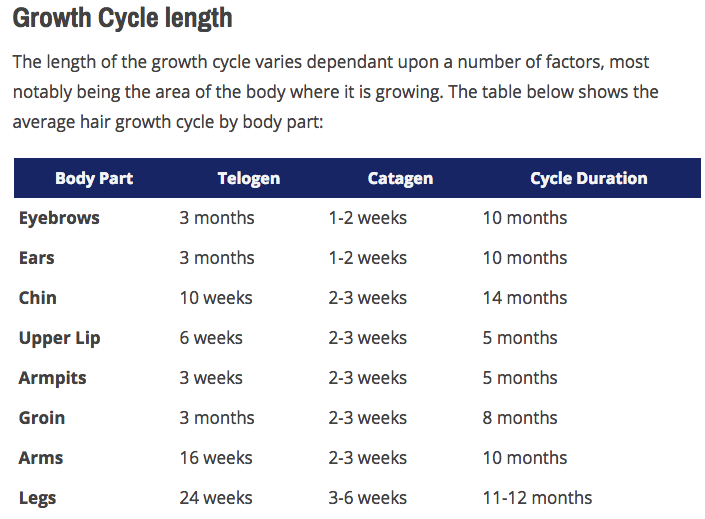
I mentioned average stage duration for your scalp, but the actual length of each stage varies by body part (more on that below).
That’s why your eyebrows are short while your scalp hair can grow long.
Source: https://hairfreelife.com/take-multiple-sessions-laser-hair-removal-work/
LHR works in the anagen phase. You’ll need to keep coming back to zap the hairs that weren’t caught before.
If you have a high density of hair follicles, that’ll also drive the need for more treatments (that was me).
How far apart are laser hair removal treatments?
As I mentioned above, the growth cycle length is different for various areas of the body. Your leg follicles spend an average of 24 weeks in resting phase, while your armpit follicles spend an average of just 3 weeks dormant.
Face, neck, and bikini area treatments will be about 4-6 weeks apart; trunk areas including chest, back, underarms, and stomach will be about 6-8 weeks apart, and legs will be 8-10 weeks apart.
Can I shave between treatments?
Yes. That’s another great thing about LHR versus waxing—you can shave normally between treatments.
How much does it cost?
I can give you a ballpark for what you can expect to spend in Iowa, but you’ll need to investigate this for your area.
A large area, like full legs, will run you around $1,700-$2,300. A smaller area, like armpits or face, will be around $800-$1,200.
For reasons that defy logic, bikini/Brazilian is counted as a “large” area, so that’ll run you about the same price as full legs.
Most clinics offer interest-free financing. I financed my legs: $1,600 spread out over 16 months. I was happy to pay $100 a month for a short time, especially if it meant never shaving again. Other discounts apply for paying in full up front.
And for Milan Laser in particular (the place I go), you get an immediate 50% off if you’re referred by a current client (their full-rate prices are $3,200 for large areas, but you’re crazy if you pay that… just find a current client by asking around on local women’s Facebook groups, and then you’ll get 50% off and that person will get a gift card for the referral).
If you want to save time and use my name, go ahead! Just shoot me a message and I’ll tell you my last name.
+++++
But I could never… (yes, you can, and maybe you should)
You might be reading this and thinking, “I could never spend that kind of money on something frivolous.”
I hear ya.
I had my first LHR experience before I had kids.
But I did a second, and then a third, LHR series after becoming a mom.
I went back and forth about the decision for a while, but after talking with my therapist, I decided to do it. Because sometimes, spending money on something that appears “selfish” is actually a really great idea with wide-ranging positive effects.* For me, less time shaving means more time with my kids, and more time doing what makes me happy.
A mom who feels comfortable in her own skin is a happier mom. When I’m happy, I’m my best self, which means I’m a better mom, friend, wife, and daughter. That’s what laser hair removal did for me.
*I’m not advocating for financial irresponsibility; if you have significant debt already, be smart with your money. LHR is a luxury to be utilized after you’re in a good place financially.
Photo by Manki Kim on Unsplash
0 Comments